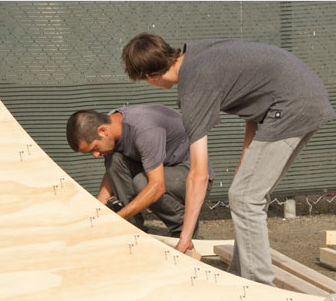
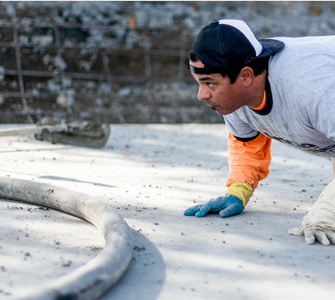
Viva La Summer!! Let's build a "Micro Quarter"! Which is a smaller than average sized quarter pipe. That and I just like saying the word micro quarter... kinda rolls off the tounge... micro quarter.
This quarter pipe is 2' tall by 4' wide. Because of it's small size, the quarter pipe is great for basements, garages and driveways. Enjoy.
Gather all your materials. Start with the 2×4's. Cut 11 pieces at 3'-10 1/2 in length (you will get 2 out of each 8' long 2×4). Set them aside.
Obviously you can make your quarter pipe any size you want. However, for this set of plans you will need to use the dimensions provided in order for the material list to be accurate.

Above you will find a plywood layout illustration, it depicts the sides and deck of the quarter pipe being cut from a single sheet of 3/4" plywood.
Theres a few different ways to do this, I'm going to explain it the way I do it. Grab an 8" long 2×4. On one end, drill a hole the diameter of a pencil (about 3/8"). Then measure from the hole you just drilled, out the distance of the transition radius. In this case, 5'-6. Place a screw there but don't go all the way through the 2×4 yet.

Take your 3/4" plywood and lay it on a fairly level surface. Grab another sheet of plywood, your 3/8" sheet should do, you might have to place some scrap wood under it to bring it up to the level of the 3/4". Place it next to the 3/4" plywood, long end to long end, touching.

With the 2×4 you made earlier, screw the screw into the 3/8" plywood where shown above. Now you want to draw a radius using the 2×4 to guide your pencil until you have the transition radius clearly visable on the 3/4" sheet of plywood. Once done, measure up 1'-11 1/4 and out 5'-1 1/4 from the bottom left side to complete drawing the transition.

Finally, draw in the coping and front details as shown above.
Very carefully cut on the lines you drew for the transition. The top layer for the deck comes out of this 3/4" ply also, so try not to get too crazy with the jig saw.
Once cut, you can use this transition as your template to trace onto the plywood and cut out the other side.
Your done with the hardest part, now it's time to frame the quarter pipe. Start by attaching the bottom and top 2×4's as shown.

Take the remaining 2×4's and frame the deck and riding surface portion by placing the 2×4's 8" on center except where noted.


To find the steel, look up "steel yards", "structural steel" or "steel fabricators" and so on in the phone book.
The actual size of the pipe you are looking for will be 2 3/8" outside diameter with a 1/4" wall thickness. This pipe is known by steel shops as...
2" OD, Schedule 80, black steel pipe.
Some steel shops are picky about what it's called so use the above name if they seem confused.

There are more than a few ways to attach the coping to the quarter pipe. In my opinion, screws are the only way. Although recently I came across another method where you can attach the coping with hook bolts (clothesline bolts) that looks promising.
I have never used this method but I'm intrested in trying it out. More on that later. For now we're using screws.
Drill a 3/8" hole on the outside of the steel coping. Now drill a 3/16" hole on the inside of the coping making sure they line up.
Once drilled, place the coping in the notch you cut out earlier. By feeding a screw through the outside 3/8" hole, place it into the 3/16" inner hole. This can be tricky but with a little patience you'll get it.

With a drill or screwdriver, screw it down and move on to the next pre drilled hole. You should have a screw on each end and one in the middle.
By the way, don't worry about the holes interfering with your skating. You'll never feel them, guaranteed (unless they are larger than 3/8").
Take the remaining 3/4" plywood, cut out a piece 4' by 2' and screw it to the top of the ramp putting screws about a foot apart in each 2×4.

Also at this time get your 3/8" plywood and cut out a piece 3'-9 by 4'-0 leaving you with 4'-0 by 4'-0 for the next layer. Start at the top and place the screws about a foot apart working your way down the ramp. Make sure you hit the studs when your attaching it.
Take the remaning 4'-0 by 4'-0 piece of 3/8" and lay it over the previous layer. Make sure you screw into the 2×4's. On a ramp this size you can lay a 2×4 across and mark where the studs are located or use a chalk line.

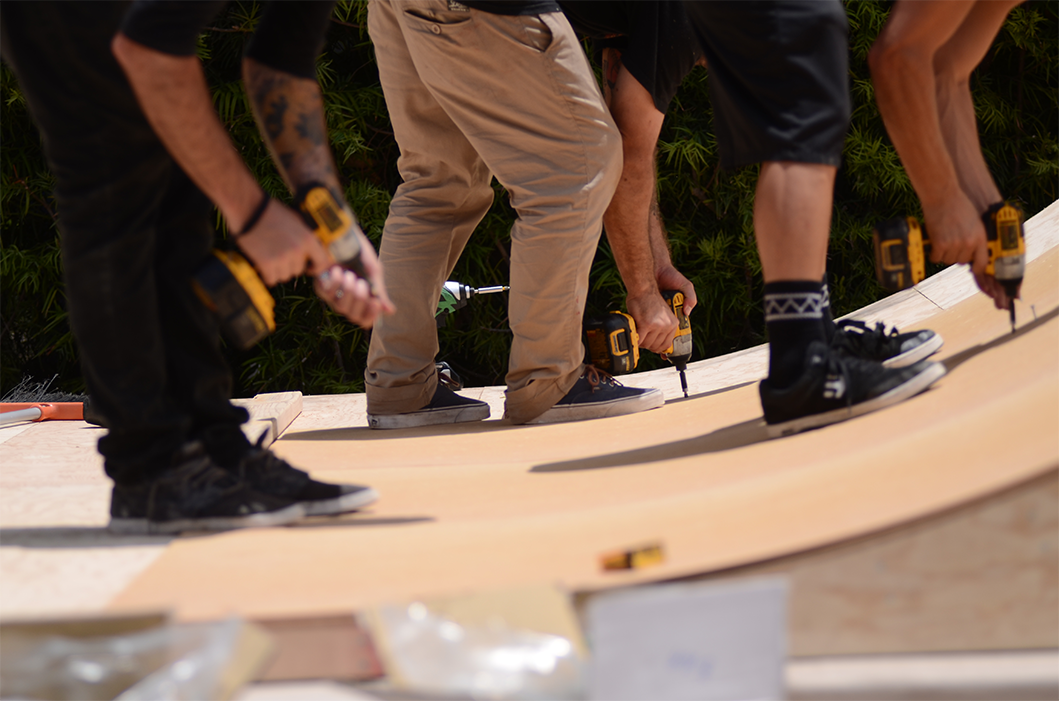
With both of the 3/8" sheets fully screwed down, cut a piece of masonite 3'-6 by 4'-0 and attach it the same way you did the last two layers. Only this time you will want to countersink your screws a little bit using a countersink bit or a 3/8" drill bit. This allows the surface to be as smooth as possible and keeps your body from being ripped to shreds during a fall.
With the masonite on you will be able to check the coping placement. I prefer the coping to stick out 3/8". If you want to change it, you can remove the coping and place wood shims where it meets the 2×4's.
If constructed properly, you should have about 1'-0 between the masonite and the ground. This is where you place the 4' x 1', 3/16" thick sheet metal or 1/4" plastic.

Drill a 3/16" hole about 2 inches in from each end on both sides and one in the middle. After the holes are drilled, countersink each by using the 3/8" drill bit to drill down just enough so the screw heads are flush.
The steel threshold is also availabe at steel fabrication shops. You may be able to find the steel at home improvement stores too. They don't have the best selection, but it might be enough to get you by.
Once again, that's it. Break out the radio and learn those pivot to fakies you've always wanted (then share the knowledge with me, I suck at that trick).
If you catch a mistake or feel something needs further explanation, please let me know.
| Related Links | |||
| ♠ Tim Brauch | ♠ Bottle Jack Press | ♠ Wood Mold | ♠ Concrete Mold |
| ♠ Glue | ♠ Screen Print | ♠ Store | ♠ Angled Ledge |
| ♠ Kicker Ledge | ♠ Stair Ledge | ♠ Spine Ramp | ♠ Grind Box |
| ♠ Block Ledge | ♠ Launch Ramp | ♠ Kicker | ♠ Tips |
| ♠ 3' Quarter Pipe | ♠ Bank Ramp | ♠ Veneer | ♠ Donate |