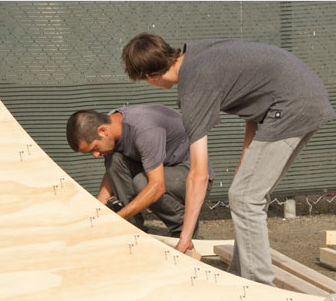
Wood skateboard molds are nice because they can be used to make a skateboard deck using all sorts of pressing techniques and they're not too expensive to make.
The wood skateboard mold I am describing here works best with clamps and aside from the tools it should cost less than 30 bucks.
I made this wood skateboard mold with these plans in mind and by following this article it's honestly not that difficult for you to make. Just make sure you have a thorough understanding of how it is done before starting.
To make this skateboard mold accessible to the beginning wood worker while retaining as much accuracy as possible, you will need to print out these section drawings. These drawings are to scale and represent both halves of the wood skateboard mold.
The line on the top and bottom of the drawing corresponds to the top and bottom of the 2×8. The lines in the center are the cut lines, lines that once cut will make up the top and bottom of the mold.
| PDF Sections | Section Zero | Section One | Section Two | Section Three |
Click here if you need Adobe PDF Reader.
Make sure these drawings are printed to scale, filling up an 8 1/2" x 11" sheet of paper in it's entirety minus a 1/4" or so on either end depending on your printer.
You can check the scale by measuring the distance between truck mounting lines. This measurement should be 2 1/8". The wheelbase dimension will measure out to 14 1/4". The top and bottom lines will be 7 1/4". The actual size of a 2×8, 1 1/2" x 7 1/4".
To save space and time, sections One through Three will be printed twice and used for both sides of the wood skateboard mold not top and bottom. You will use Section Zero once, for the center 2×8.
The top and bottom sections are on one single sheet. Refer to the illustration to determine which section corresponds to which 2×8.
Gather all your materials. Start by cutting two 12' long 2x8's into 34" lengths. You will need a total of seven. Piece your printed Section Drawings together end to end as shown here.

They are only going to add up to 33" in length so your going to have to free hand that extra half inch on each end.
At this point you should have your 2×8's cut to 34" and your Section Drawings (patterns) printed and taped together. Now it's time to put the patterns on the 2×8's.
Using spray adhesive, spray the pattern and center it on the 2×8. The wood will have 1/2" exposed on each end.
By gluing the patterns on, you can just follow the lines with a jigsaw and peel off the drawings when your done. Plus it's more accurate than tracing.
Place the cut 2×8's on a flat surface. They should resemble stairs. Trace their outline onto the piece next to it. For example, on the top skateboard mold, you would trace 3 onto 2, 2 onto 1 and 1 onto 0.
Now you can remove the excess wood by chiseling down within an 1/16" or so of this newly drawn line.
You can also use a heavy grit sandpaper wheel on an angle grinder. 40 or 60 grit should do the trick.
It will remove the excess wood quickly, almost too quickly so be careful not to take off too much.
Do this one piece at a time and try not to remove any wood from the sawn edge.
After you have them looking similar to a finished skateboard mold, brush the sawdust off and set them aside.
Get out your wood glue and paint roller. A four inch foam roller with small paint tray and regular wood glue like Titebond works well.
Begin putting the shaped 2×8's together by rolling glue onto both pieces, starting with piece number 3. Attach it to piece number 2 with clamps. Now, while the clamps are in place, screw them together using about 3 screws. The screws will be left in for extra strength.
Unclamp and attach the glued set to piece number 1 using glue, clamps and screws. Repeat until done. After you've done both halves, allow the glue to dry overnight to prepare for finishing.
Now that the glue is dry, sand the inside edges smooth to finish the skateboard mold. Again, make sure you don't remove too much wood. You just want to have each 2×8 meet the previous one.
An orbital sander with 60 to 80 grit sandpaper works good here. When all the edges meet, use progressively finer sandpaper until smooth.
Last, you want to paint the mold with a wood primer. Gesso works great for this.
When using this wood skateboard mold to press a deck, it's a good idea to use a thin layer of cork about 1/4" thick on both sides of the veneer plies to make up for any imperfections in your mold.
You can use about 10 pipe clamps (5 on each side) or the equivalent to press decks with this mold. They will provide more than enough pressure if left overnight to dry.
For additional strength you can add an epoxy or epoxy/fiberglass finish to protect the surface of the skateboard mold.
One last thing, this wood skateboard mold is only as accurate as you make it. Take your time, have patience and a good understanding of the process.
Your mold will not look exactly like these photos. I made that mold with 2×6's before realizing that 2×8's would work better for a wood skateboard mold. As you can see by how thin the top is.
If you catch a mistake or feel something needs further explanation, please let me know.
| Related Links | |||
| ♠ Tim Brauch | ♠ 3' Quarter Pipe | ♠ Press | ♠ Concrete Mold |
| ♠ Glue | ♠ Screen Print | ♠ Store | ♠ Angled Ledge |
| ♠ Kicker Ledge | ♠ Stair Ledge | ♠ Spine Ramp | ♠ Grind Box |
| ♠ Block Ledge | ♠ Launch Ramp | ♠ Kicker | ♠ Tips |
| ♠ 3' Quarter Pipe | ♠ Bank Ramp | ♠ Veneer | ♠ Donate |