|
||||
|
|
||||
|
||||
|
||||
|
||||
Do you want to know how to make a grind rail?
Well, to tell you the truth, I was kind of avoiding the writing of this article for a few different reasons.
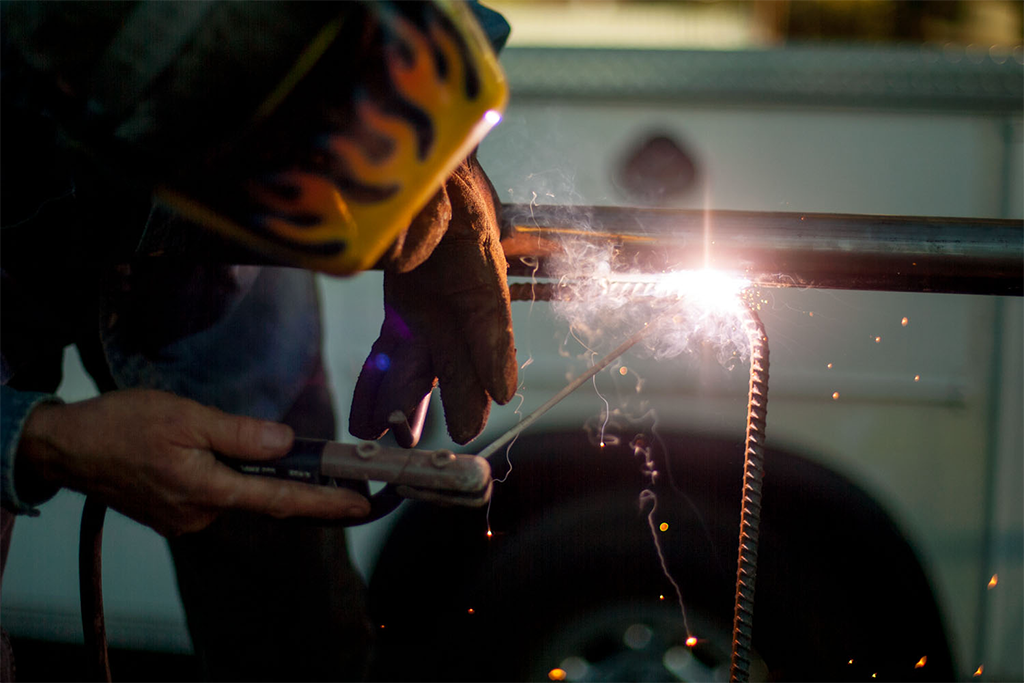
♠ First, to make a grind rail, it's best that you weld it.
Not everyone has a welder or knows how to use one.
♠ Second, there are a couple different ways of making a grind rail without a welder, but to be honest, that style of rail has never gotten much attention at the skateparks. It seemed as if it's lighter, welded brother was always the rail of choice.
♠ And third, there's really not that much to a grind rail... what I mean by that is, it's pretty self explanatory. Then I realized that there are a couple things you should probably know.
Never fear, all of you eager do it yourselfers. After receiving quite a few emails asking "When are you going to do a rail?", here it is.

To find the steel, look up "steel yards", "structural steel" or "steel fabricators" and so on in the phone book.
The actual size of the pipe you are looking for will be 2 3/8" outside diameter with a 1/4" wall thickness. The same pipe that would be used as coping on any ramp.
This pipe is known by steel shops as...
♠ 2" OD, Schedule 80, black steel pipe.
For the square steel tube, the dimensions are 2" by 2" square, with a 1/8" to 3/16" wall thickness.
This steel is known by shops as...
♠ 2" Sq. Tubing. You will have to designate the thickness.
If you plan on leaving your grind rail outside, you will want to use pressure treated wood, water sealant or paint on the wooden ones and at the very least a primer for the all steel rails. Personally I wouldn't leave either outside.
First let's start with the all steel version of the grind rail.
This style of rail requires that you have a welder or have access to someone who can weld.

If you have the opportunity to learn welding, by all means give it a shot. I'm not going to go into detail on how to weld, but I will say it's a lot easier than you would think and it's also a lot of fun.
Decide whether you're going to use square or round tubing, gather your materials and assemble.
Let's say you wanted to make a square rail at about 6' long by 9" tall. You would cut two pieces of square tubing at 6 3/4" for the legs and one piece at 6' for the rail its self.

You also need two feet made from 3/16" × 4" × 1'-0 plate steel. The feet are always going to be as long as the rail is tall plus about 3 inches. 4 inches wide is plenty, unless you're building a mammoth rail.
Mark the center of the feet and weld the legs into place making sure they are perpendicular to the feet. Now lay the 6' tube on top of the legs, making sure everything is level and weld it together.

However tall the rail is, that's the distance in from the end of the grind rail that the legs are attached. In this case the legs are placed 9" in on each end.
Tip: If you feel creative, you can make one leg longer than the other for a slanted rail.
What's that? You would rather skate a round rail, no problem. As a matter of fact, I would too.
This rail is going to be 6' long by a foot tall. So that means you'll need to cut one piece at 6'-0 and two the legs at 9 5/8" long.

If you have a grinder, it is best that you cut the legs about an inch longer (10 1/2" or so) and grind a semi circle notch into the tops of the legs. This is not necessary but it will make it easier to weld.
Again you will also need two feet made from 3/16" × 4" × 1'-3 plate steel. Mark the center of the steel plate and weld the legs perpendicular to the feet.

Place the steel pipe on the legs and weld them in place. Since this rail is 6' long, you will want to place the legs in about 6" from the end.
Steel fabricators will also weld the rail together for you if you provide them with the dimensions - and some money. This should still be cheaper than buying a rail.
These are the same as the all steel rails except there's no welding involved. Regardless of whether you choose a round or square rail, these are made the same way.


First, gather two 2×4's and one 2×6. Cut them the length of your rail.
Using 2 1/2" screws, center and attach one of the 2×4's on it's side on top of another 2×4 flat. Screw from the bottom of the flat 2×4 up into the 2×4 on it's side.
Now, using more 2 1/2" screws, center and attach the 2×6 flat under the 2×4's. Screw them together from the top down.
For stability, you'll need to place a 7" wide layer of 1/2" plywood to the outside of this structure with 1 5/8" screws.
If you chose to cover the ends with a piece of 1/2" plywood, cut your 2×4's and 2×6 an 1" shorter to compensate for the thickness of the plywood.
This rail is 6 1/2" tall. Add another flat 2×4 to make it 8" in height.
Now attach the rail. Drill a 3/8" hole, 2" in from each end, on each end, on the top of the rail.
Drill a 3/16" hole, below the 3/8" hole, on the inside. This is so you can thread a 1 5/8" screw through the top hole and into the bottom hole to attach the rail.

For every 4' the rail is in length, add another screw in the middle. For example, an 8' long rail would have four 1 5/8" screws holding it down. A 4 foot rail, only three screws.
Also add the ends now if you decided to use ends.
If you want to make the rail taller, add more 2×4's in the middle. You will need to make the base wider after the addition of an extra 2×4 though. Use a 2×8 to do that.
And that's how you make a grind rail.

This is not the only way to make a skateboard grind rail. Make what works for you, from what you have.
Good luck!
Your comments and suggestions are welcome • Contact
How To Make Ramps • How To Make Skateboards
Related Pages |
|||
| ♠ Grind Box | ♠ Launch Ramp | ♠ 2' Quarter Pipe | ♠ 3' Mini Ramp |
| ♠ Kicker | ♠ 3' Quarter Pipe | ♠ Store | ♠ Donate |